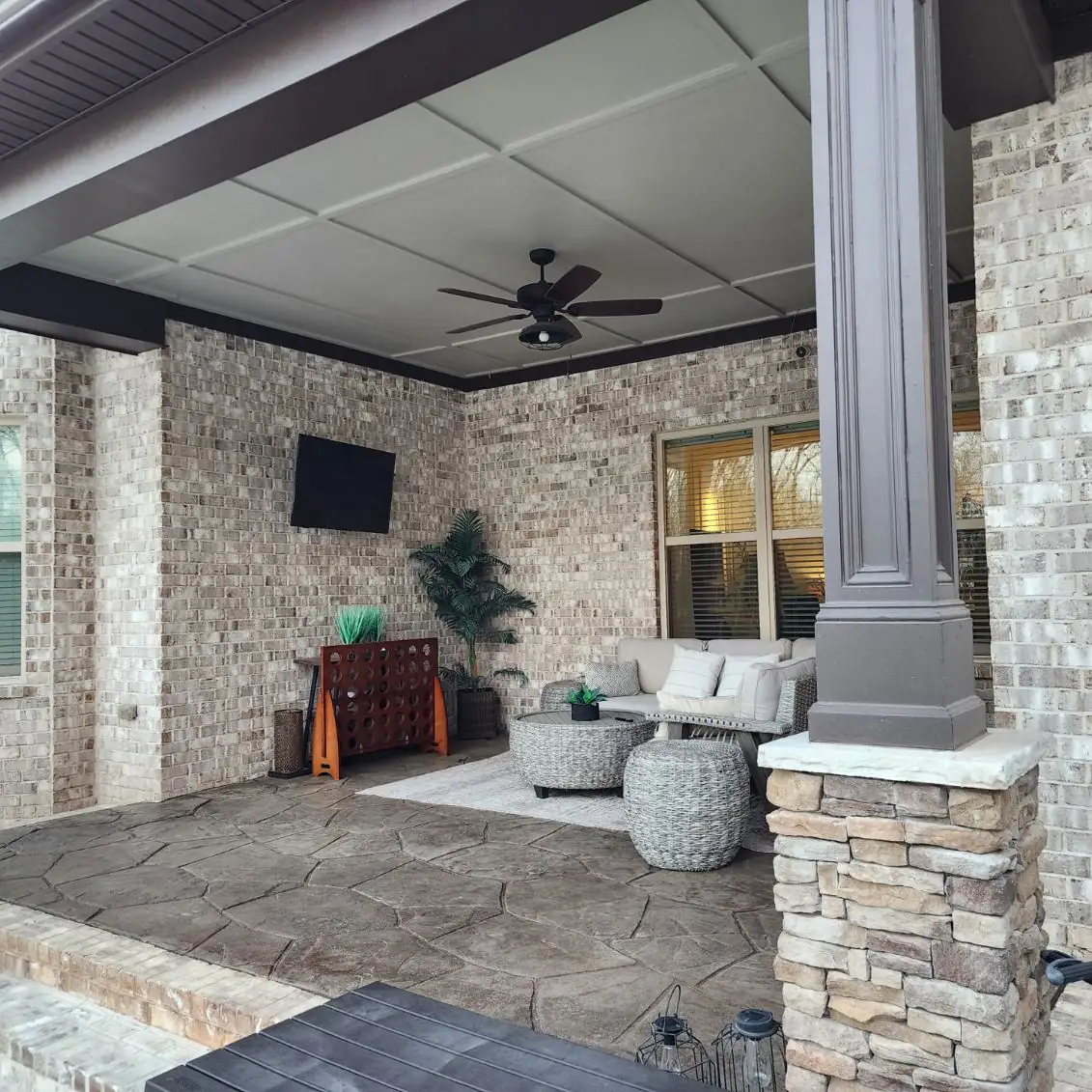
What Stamped Concrete Is and How It Works
After the pour, color is either mixed through the concrete or applied to the surface. While the concrete is still workable, mats shaped like stones, bricks or boards are pressed into it. Once it cures, a sealer protects the color and sets the finish.
Under the pattern it is the same strong concrete as any slab, so the base, thickness and joints matter just as much.
Why Stamped Concrete Suits North Alabama Homes
Natural stone is beautiful but costly, and loose pavers can shift and sprout weeds on clay soil that swells and shrinks. A stamped slab is one continuous surface, and a good sealer helps the color and pattern hold up to rain and summer sun.
It also lets you match your house. A brick-style border can echo your foundation, while a slate texture suits a modern look.
Where Stamped Concrete Works Best
- Backyard patios and outdoor kitchen areas
- Pool decks
- Front walkways and entry landings
- Porch floors and steps
- Accent bands and borders along driveways
For a plain broom-finish patio, see our concrete patio page. For vehicle use, our concrete driveway page explains thickness and prep. For paths, see our concrete sidewalk page.
How We Install Stamped Concrete
Stamping has a narrow window, so every step is planned before the concrete arrives.
Before the Pour
Step 1: Choose Pattern and Color With You
We talk through your siding, roof and landscaping, and narrow down options. Colors look different in daylight, so we encourage you to judge them outside.
Step 2: Prepare the Ground, Base and Forms
Grading, compacting and form-building follow the same standards as any slab. Decorative work only looks good on a base that is flat and firm.
Pour and Stamp Day
Step 3: Pour and Add Base Color
We place the concrete, level it and add color, either mixed through the slab or applied to the surface.
Step 4: Apply Release Agent
A powder or liquid release keeps the mats from sticking. It also adds a second shade that gives depth, like natural variation in stone.
Step 5: Press the Pattern
This is the timing-sensitive step. If the concrete is too wet, the pattern slumps. If it is too firm, the pattern will not take. We bring extra crew so the pressing happens in the right window.
After the Pour
Step 6: Cut Joints and Clean Up
We cut joints along pattern lines where possible so they blend in, then wash off the excess release.
Step 7: Cure and Seal
Once the concrete has cured, we seal the surface. The sealer brings out color, protects against stains and affects how slick or textured the finish feels.
Choosing Patterns, Color and Scale
Popular Patterns
- Ashlar slate: irregular flat stones that suit casual yards
- Flagstone: natural-looking pieces with varied edges
- Cobblestone: small rounded stones for a classic feel
- Brick: running bond or herringbone styles
- Wood plank: the look of weathered boards
Getting Color Right
A base tone plus a contrasting release color gives a more natural, stone-like effect. We often suggest slightly muted shades, because they age well and blend into landscaping. A darker border frames a patio and makes it look intentional.
Matching Pattern Scale to the Space
Large stone patterns suit big patios, while small cobblestone can look busy on a narrow path. We sketch the layout on the ground with chalk so you can see how the lines run, where borders fall and how the pattern turns at corners.
Texture, Safety and Pool Decks
A glossy sealer can feel slick when wet. For pool decks, steps and sloped paths, we use a sealer with added traction. Lighter colors also stay cooler under bare feet.
Drainage matters most at a pool, because water should run away from both the pool edge and the house. Tell us early if a pool is planned, since the deck layout and joint spacing depend on the pool design.
Stamped Concrete vs Pavers vs Natural Stone
Natural stone offers the most authentic look but is costly to haul and set. Pavers are modular and easy to repair, but joints can sink or sprout weeds. Stamped concrete sits in between: one continuous surface, strong under weight and quicker to install than thousands of individual pieces.
The trade-off is repair. If a stamped slab cracks, a patch will not match perfectly, because the color and texture were created in one moment. That is why base preparation and joint placement get so much attention.
What Affects the Cost of Stamped Concrete
Decorative work takes extra labor, materials and skill, so it usually costs more than a broom-finish slab. These factors move the price:
- Area, thickness and base preparation
- Pattern complexity and number of color layers
- Borders and accent bands
- Type of sealer
- Site access
We often quote a plain version and a stamped version side by side so you can compare. We also show which parts, such as hidden corners, could stay plain to save money.
Caring for Stamped Concrete
- Sweep and rinse regularly
- Clean with a mild cleaner, not harsh acids
- Reseal about every 2 to 3 years, or when water stops beading on the surface
- Keep planters and furniture from trapping moisture against the slab
A dull or faded surface does not always need replacing. A thorough cleaning and fresh sealer often bring the color back, and small cracks can be filled and tinted. We tell you plainly if a surface is past saving, and our concrete replacement page covers the next step.
Weather and Timing for Decorative Pours
Stamping needs a calm, predictable day. Strong wind and hot sun dry the surface too fast, and sudden rain can ruin a fresh pattern. We schedule decorative pours for stable forecasts, and we postpone rather than gamble with your surface.
Why Homeowners Choose Property Transition Company
- Veteran-owned. We say what we mean and show up when we say we will.
- Licensed and insured. We are a licensed Alabama residential builder with full insurance behind every job.
- Honest advice. If plain concrete suits your plan better, we tell you instead of selling a pattern you do not need.
- Labor discounts. Seniors, active-duty military and veterans can ask about our labor discount.
Where We Install Stamped Concrete
We install stamped concrete in Huntsville, Madison, Owens Cross Roads, Hazel Green, Harvest, Meridianville, New Hope, Gurley, Athens, Decatur and Scottsboro. If you are nearby and not on the list, call and ask. You can see the full service area on our homepage.
Get a Free Stamped Concrete Estimate in Huntsville, AL
Tell us what you picture, where it will go and the look you like. We will visit the site, show you pattern and color options and send a free written estimate with no obligation.